The 20th century will be forever remembered for the birth of two new fundamental theories of physics, namely Relavity e Quantum Mechanics.
Special Relavity and Quantum Mechanics have been merged into the highly successful Standard Model of Particle Physics, which describes the building blocks of our world at the microscopic scale up to a millionth of a billionth of a meter.
Instead, General Relativity, which with a comparable success describes gravity and what happens at the astronomical scale, has remained a theory by itself and has stubbornly refused to be unified in a common theoretical framework with Quantum Mechanics.
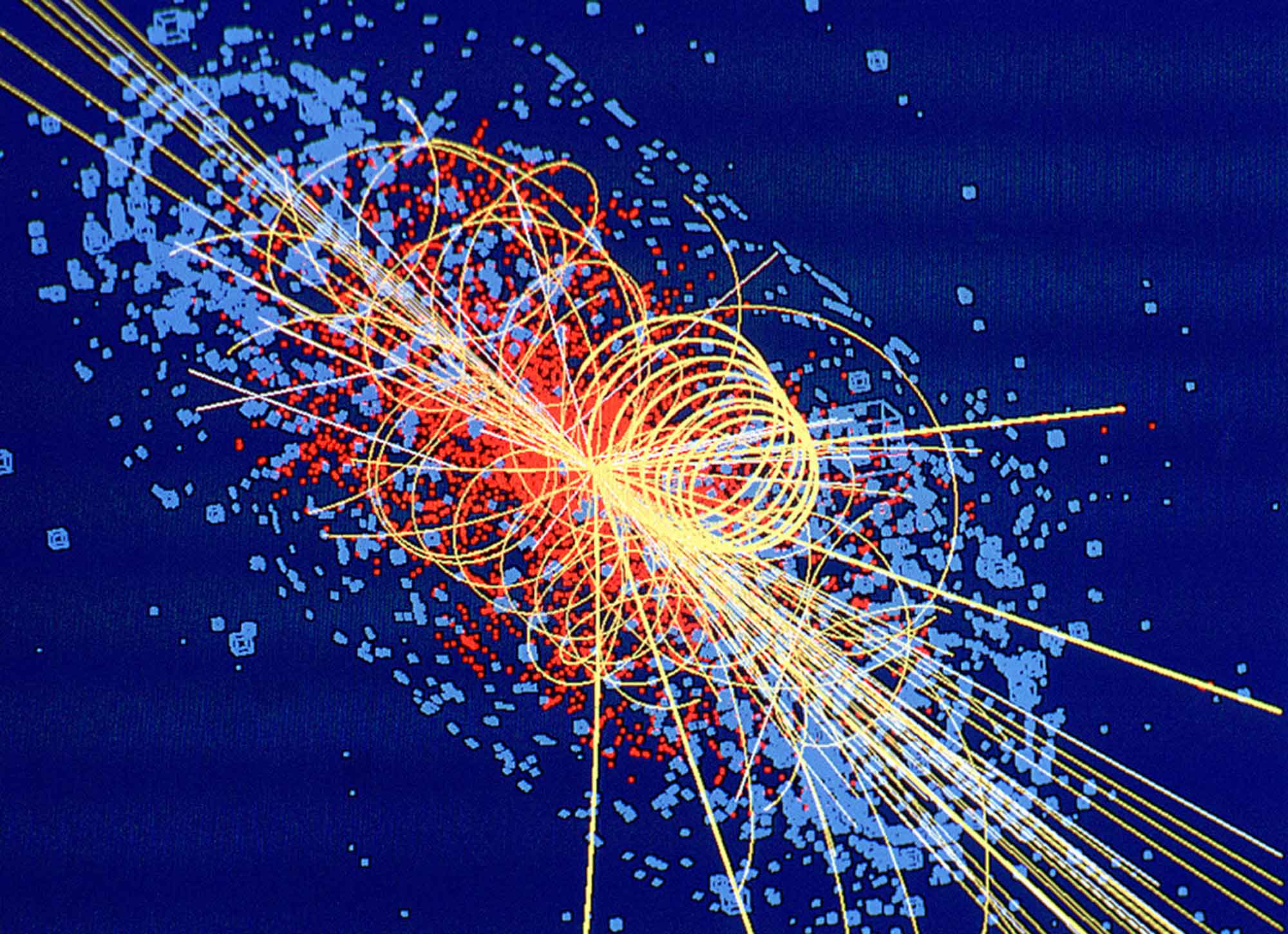
The Large Hadron Collider (LHC) was build to investigate the question further but has hitherto failed to provide new clues, beyond confirming the existence of the Higgs boson, the 'fog' particle responsible for 'slowing down' many others, giving them mass in the process.
I have a degree in Physics, though I gave up studying it after graduation.
I bet that further advances will be made along two lines.
On the one hand one striking difference between the Standard Model and General Relativity is that the geometrical space and the simmetries that characterize the former are complex while the those that inform the latter are real. Complex and real here refer the kind of mathematical numbers in use in the physical description. So it must be that complex mathematics is linked to the quantum description, while real mathematics describes reality at a classical level.
Since complex numbers are characterized by an amplitude and a phase, the amplitude being the 'real' part, and the phase the aspect unique to complex numbers, it must be that the transition from the quantum microscopic world to the classical macroscopic one is described mathematically by a sort of phase 'freeze', so that mathematically the complex description is replaced by the real description as the quantum behaviour fades into the more familiar classical one.
One the other hand another striking difference between the Standard Model and General Relativity is that in the latter there is a local simmetry (Lorentz simmetry) which acts on a space that is a local linearization of the geometry of the underlying manifold, while in the former the local simmetry (Yang-Mills simmetry) lacks a similar underlying manifold but istead rests as a 'guest' simmetry upon the very same manifold described by General Relativity.
So my bet is that, to mimic mathematically General Relativity, a complex manifold space underlying the Standard Model should be introduced , while General Relativiy, to mimic mathematically the Standard Model, should be reformulated using complex mathematics to include a quantum description that is currently lacking. While these are very general and broad guidelines, maybe obvious to most physicists, I don't find them often clearly stated.
It will become clear that the forces described by the Standard Model are a macroscopic consequence of these hidden dimensions whose existence I'm taking for granted. Also the relationship between complex numbers and quantum mathematics will become clearer.
Showing posts with label physics. Show all posts
Sunday, March 26, 2017
Tuesday, December 29, 2015
Light speed
Often it's said that Relativity doesn't allow any information to travel faster than the speed of light.
That's exaggerate and not true.
It's been shown that quantum entanglement allows information to travel faster than the speed of light. If a system is entangled, meaning it's a superposition of two states, when an interaction causes the system to fall into one of those two states, that happens instantly everywhere irrespective of how big the system is.
So, for example, if two photons get entangled and then one of them is sent to a nearby galaxy, afterwards the system comprising the two photons stretches from our galaxy to the nearby one, and, irrespective of that, an interaction with the local photon can cause an instant change in the distant one located in the another galaxy.
So information can move instantly whatever the distance.
I think, but I'm not going to prove it, that the limitation due to the speed of light regards only energy and momentum, not information.
That is not surprising, because it can be shown that the fact the laws of physics are the same everywhere causes energy and momentum to be conserved during the evolution of a system. So energy and momentum are deeply connected with the structure and geometry of spacetime, in a way that their transfer is subject to the geometrical laws of spacetime (of which the speed of light is just an aspect).
Information instead, and who knows what else, can move instantly.
In the above example, sending the photon to the nearby galaxy is a transfer of energy, that's why it's subject to the speed of light limit. But once energy is in place, that limit doesn't apply to information transfer.
So, if I may end on a sci-fi note, one may imagine harvesting photons entangled from the beginning of the universe to send information instantly to every corner of it.
Subscribe to:
Posts (Atom)

